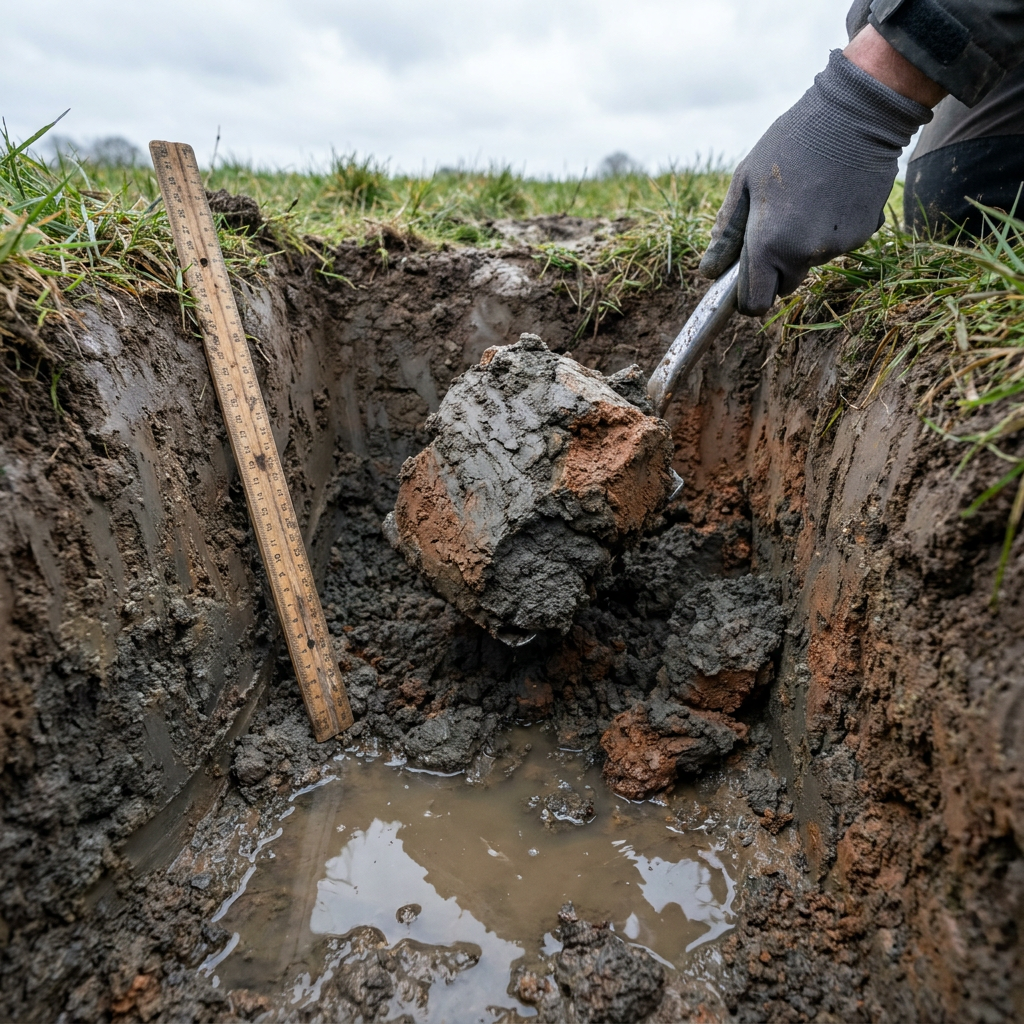
If you’re building off mains drainage — whether that’s a barn conversion, a rural new build, or an extension with a new drainage run — the question of where your water goes matters enormously. A soakaway sounds simple, but on the wrong ground it will fail, and the test that tells you whether your ground is the right ground costs a fraction of the bill you’ll face if you skip it.
Key Takeaways
- A soakaway is a designed drainage structure, not just a hole in the ground — it must be sized against a measured soil infiltration rate.
- The only way to know whether your subsoil can accept a soakaway is a percolation test carried out before construction, following BRE Digest 365.
- Heavy clay has very low permeability — on clay, infiltration often fails the test entirely, and you must move to an alternative: attenuation with controlled release, or a consented discharge to a watercourse.
- Surface water must never be combined with treated foul effluent from a package treatment plant; each stream needs its own separately designed and tested drainage field.
- A soakaway sized “for costing purposes” is not a designed soakaway — treating it as one is how expensive failures happen.
How one skipped test became an expensive rebuild
The job that prompted this article was a Class Q barn conversion in the East of England — an agricultural building being converted to a dwelling, sitting well outside any mains drainage network. Surface water from the roof and hardstanding was to discharge to a soakaway. Foul drainage was handled by a package treatment plant, with its treated effluent also discharging to ground.
The drainage drawing was honest. It carried a clear note: “soakaway for costing only — design and percolation test to be confirmed before construction.” That note existed for good reason. The engineer who produced the drawing knew the ground hadn’t been tested and that the subsoil in that area was likely to be heavy, low-permeability clay. The note was a flag, not a green light.
What happened next is unfortunately common. The contractor priced the pit, treated the percolation test as someone else’s responsibility, and built a single soakaway to accept both the surface water and the treatment plant’s effluent combined. No percolation test was ever done. After the first prolonged period of heavy rain, the soakaway surcharged. Water backed up, the ground around the pit became saturated, and the system failed visibly. The subsoil was exactly what the note had warned about: heavy clay that water simply cannot disperse through at any useful rate.
The result was an expensive dig-up, a redesigned drainage scheme, and a delay to occupation. Every penny of that cost was avoidable. The percolation test that would have caught this costs a small fraction of what the remedial work cost.
What Approved Document H actually says
Part H of the Building Regulations covers drainage and waste disposal. It sets out a clear hierarchy for surface water disposal, and it matters because it isn’t optional — it’s the regulatory framework your drainage scheme must follow.
The hierarchy runs in this order: infiltration to the ground first (a soakaway or drainage field), then discharge to a surface watercourse, and only as a last resort, connection to a public sewer. The intent is to manage surface water as close to source as possible and to reduce pressure on combined sewer systems.
Crucially, Approved Document H doesn’t say “build a soakaway if you have space.” It says infiltration is the preferred option — but only where the ground is suitable. Suitability has to be demonstrated, not assumed. That demonstration is the percolation test. If the test shows the ground cannot accept water at an adequate rate, you don’t get to build a soakaway and hope for the best. You move down the hierarchy to the next option.
This is the step that was skipped on the barn conversion. Nobody tested the ground, so nobody knew the hierarchy required them to move straight to option two. A consented discharge to a watercourse — requiring agreement from the Lead Local Flood Authority and potentially the Environment Agency — would have been the correct route. It takes longer to arrange. It costs more to design. But it works.
The percolation test: what it is and why it has to come first
BRE Digest 365 is the established method for soakaway design in the UK. It’s what Building Control will expect to see referenced in your drainage calculations, and it’s what any competent drainage engineer will use.
The process starts with a trial pit — typically 300 mm square, dug to the proposed invert level of the soakaway. The pit is filled with water and allowed to drain. This is repeated several times to saturate the surrounding soil before the actual measurement is taken. You then measure how long it takes for the water level to drop by a set amount. From that, you calculate the soil infiltration rate, expressed as a value called Vp — the time in seconds for water to drop 1 mm.
That infiltration rate is then used to size the soakaway storage volume. The design storm is typically the 1-in-10-year rainfall event for your area, and the soakaway must be large enough to store the peak inflow while the ground slowly absorbs it. On permeable sandy or gravelly subsoils, the numbers work comfortably. On heavy clay, the measured Vp is so high — meaning water drains so slowly — that the required storage volume becomes impractically large, or the test fails the infiltration criteria altogether.
When the test fails, that’s not a problem with the test. That’s the test doing its job. It’s telling you the ground cannot support a soakaway, and that you need to design something else before you start digging.
Clay subsoil: why infiltration so often fails
Clay is a fine-grained soil with very low hydraulic conductivity. Water moves through it extremely slowly — sometimes almost not at all. In a percolation test on heavy clay, you’ll often see the water level barely drop over the measurement period. The calculated infiltration rate comes back so poor that no practical soakaway could be designed to meet it.
This isn’t unusual in large parts of England. Much of East Anglia, the Midlands, and parts of Yorkshire sit on clay-dominant geology. If your project is in one of these areas and you’re planning a soakaway without a percolation test, you are taking a significant risk.
The honest engineering answer on heavy clay is usually this: a soakaway won’t work here. Accept that early, design accordingly, and the project still moves forward — just via a different drainage route. The alternative is to build the soakaway anyway, watch it fail, and then have that conversation while standing next to a waterlogged pit and a builder asking who’s paying to fix it.
The second mistake: mixing surface water with treated foul effluent
The barn conversion made a second error that compounded the first: surface water and the treated effluent from the package treatment plant were directed into the same soakaway.
These two streams must be kept separate, and Approved Document H is clear on this. A package treatment plant discharges treated effluent to a drainage field — a network of perforated pipes laid in gravel trenches, designed to distribute effluent slowly across a large area of subsoil. The sizing of that drainage field is governed by its own separate porosity test, carried out to a different method (referenced in Part H and in BS 6297), and the drainage field must be sited away from watercourses, boundaries, and buildings.
A surface water soakaway and a foul drainage field are not interchangeable. Combining them overloads both the hydraulic capacity and the biological treatment process. On clay, where neither stream can disperse effectively anyway, the result is rapid saturation and failure.
If you’re installing a package treatment plant, commission the porosity test for the drainage field as a completely separate exercise from any surface water drainage design. They are different structures, tested differently, sized differently, and located differently.
What “for costing only” actually means
Drawings sometimes carry notes like “soakaway — for costing only, design TBC” or “indicative drainage layout — subject to ground investigation.” These notes exist because the engineer producing the drawing doesn’t yet have the site data needed to produce a proper design. They are not permission to build.
A soakaway shown on a drawing without a tested infiltration rate and a calculated storage volume is a placeholder. It tells your quantity surveyor there will be a soakaway somewhere so they can allow a budget line. It does not tell your groundworker to dig a pit of that size in that location and connect it up.
Before any soakaway is built, you need: a percolation test result, a soakaway design based on that result, and confirmation from Building Control that the design is acceptable. If any of those three things are missing, the soakaway should not be built. The cost of getting them in place is small relative to the cost of building something that fails.
When to call a structural engineer
Drainage design for off-mains properties sits at the intersection of civil engineering, Building Regulations, and planning conditions — and it’s easy for things to fall between the gaps on self-build and conversion projects where different contractors handle different packages. If you’re taking on a rural conversion or new build without mains drainage connections, get a drainage engineer or structural engineer involved before groundworks start, not after. If your soakaway has already been built and is showing signs of surcharging or slow drainage, don’t wait for a full failure — get a professional assessment of whether the drainage scheme is fit for purpose and what the compliant alternatives are. The soakaway percolation test before building is the cheapest insurance you can buy on an off-mains drainage project.
Need expert eyes on your project?
I am a Chartered Structural Engineer (CEng, MIStructE) based in Huddersfield. The Beam Doctor offers homeowners and builders:
- Steel beam (RSJ) calculations — Eurocode-compliant, Building Control-ready, in 5 working days. See all services and current fees →
- Defect investigation — I attend your property, inspect the cracking or movement, and give you a written opinion on the cause. The site visit is included in the price. See the fee bands →
- Structural Engineer’s Report — a signed desk-based opinion on a single structural concern, for a mortgage lender or an insurance claim. Request a report →
- On-site attendance — a Chartered Engineer at your property, tiered by duration. See site visit fees →
Current fees for every service are listed on the services page.