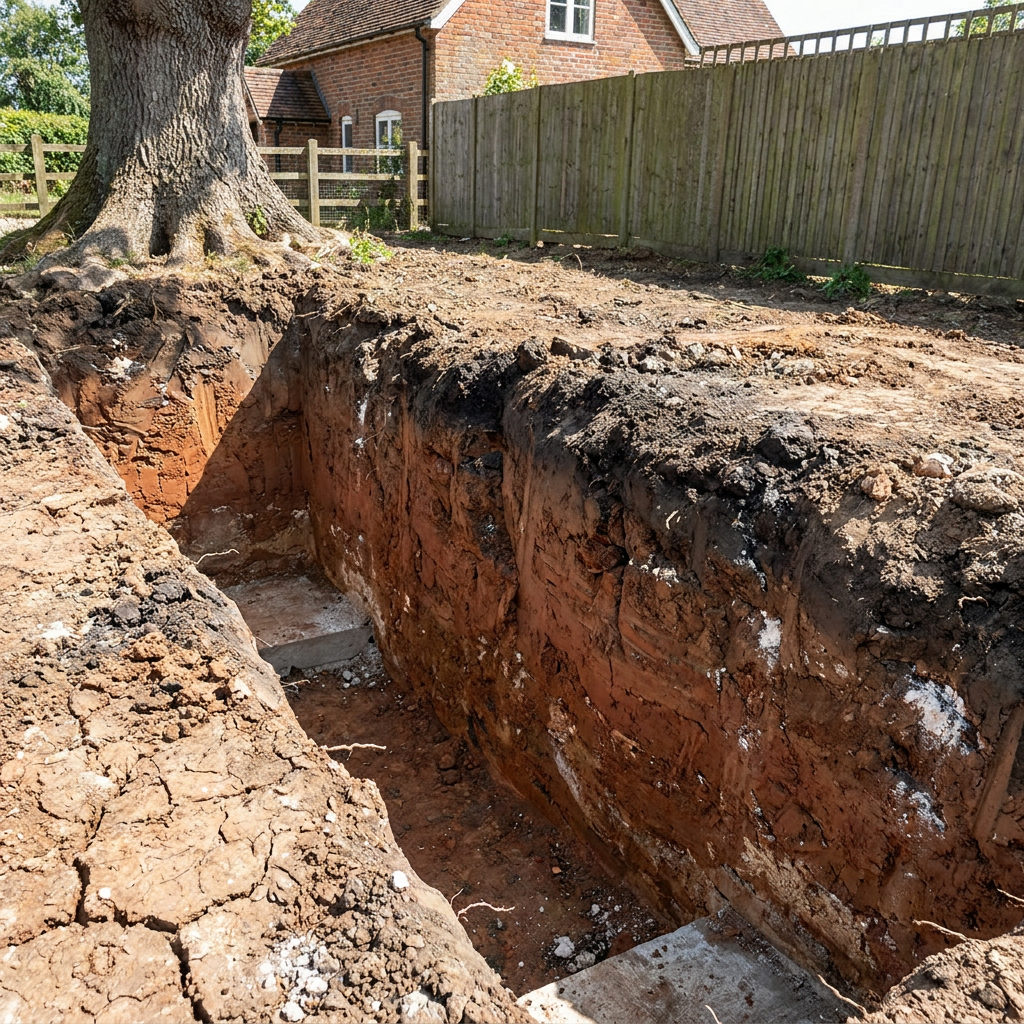
You’ve got planning permission, you’ve chosen your plot, and you’re ready to start building. But if your ground is clay and there are mature trees nearby, the depth of your foundations isn’t something you can estimate from a standard detail — it’s something the ground itself dictates, and getting it wrong in either direction costs you.
Key Takeaways
- On shrinkable clay soil, foundation depth is governed by ground conditions and tree proximity — not by the size or weight of the building above.
- Three factors drive the required depth: the clay’s plasticity (its volume-change potential), the water demand of nearby tree species, and the ratio of distance to mature tree height.
- A site-specific geotechnical investigation — trial pits or boreholes with soil classification and plasticity testing — is what fixes the design depth. A desk study alone won’t do it, and Building Control won’t accept assumptions.
- The realistic outcome on high-plasticity clay near mature trees is a foundation significantly deeper than the “typical” 900 mm — often with additional heave precautions built in.
- Commission the ground investigation and get the foundation design confirmed by a structural engineer before you submit drawings to Building Control, not after.
The assumption that catches self-builders out
I was asked to design the foundations for a pair of new houses — one semi-detached, one detached — with garages, on a sloping plot in the East of England. The subsoil was firm, expansive, shrinkable clay. There were mature trees close to the building footprint. On paper, these were modest two-storey houses. Nothing unusual about the superstructure. But the ground changed everything.
The most common mistake I see at this stage is the assumption that a two-storey house gets “two-storey house foundations.” People — and sometimes builders — reach for a standard detail: a trench-fill to 900 mm, maybe 1.0 m to be safe, and they move on. On stable, non-shrinkable ground with no trees nearby, that might be perfectly adequate. On shrinkable clay with mature trees in the vicinity, it can be a serious under-design. The house gets built, the trees keep growing, the clay keeps cycling through wet and dry seasons, and three or four years later the cracking starts.
The other mistake is over-building blindly — going very deep without understanding why, which wastes money and still doesn’t prove to Building Control that the design is justified. What fixes the depth is evidence: a proper site investigation that characterises the ground and lets you apply the correct design framework.
Why clay soil behaves differently
Clay is a volume-change material. In wet conditions it swells (heave); in dry conditions it shrinks. The degree to which it does this is measured by its plasticity index — a laboratory result from the site investigation that classifies the soil as low, medium, or high plasticity. High-plasticity clay moves more, and the foundation depth required to get below the active zone of seasonal movement increases accordingly.
In the UK, much of the Midlands, the South East, and parts of Yorkshire sit on shrinkable clay geology. If you’re building on it, this isn’t a rare or unusual problem — it’s the normal design condition for that ground. The issue is that it’s invisible. You can’t see plasticity index by looking at the soil. You can’t feel heave potential. You need a test.
Shrinkable clay is classified under a well-established framework. The design guidance I work to — including BS 8004 and Eurocode 7 (BS EN 1997) for geotechnical design — requires that the soil be properly characterised before you set a foundation depth. On this job, that meant commissioning trial pits with laboratory testing to establish the plasticity of the clay at the relevant depths. That result, combined with the tree data, was what drove the design.
What trees actually do to the ground
Trees extract moisture from the soil through their root systems. On shrinkable clay, that moisture extraction causes the clay to shrink — sometimes significantly — in the zone around and beneath the tree. When the tree is removed or dies, the clay rehydrates and swells back. Both movements — shrinkage during the tree’s life and heave if it’s ever removed — are risks to a foundation that isn’t deep enough to sit below the active zone.
The NHBC Standards Chapter 4.2, “Building near trees,” provides the framework that governs minimum foundation depths in this situation. It’s the standard I applied on this job and the one Building Control will expect to see referenced in your submission. Three things feed into it:
- Soil classification: The plasticity index from your site investigation places the clay in a low, medium, or high volume-change category.
- Tree species: Different species have different water demands. High-demand species — oaks, willows, poplars — require greater foundation depths than low-demand ones at the same distance.
- Distance-to-mature-height ratio: The zone of influence is defined by comparing the horizontal distance from the tree to the building against the tree’s mature height. The closer the tree relative to its mature height, the greater the required depth.
On this plot, the combination of high-plasticity clay and mature trees at relatively close proximity meant the required foundation depth was well beyond what a standard detail would have provided. That’s not unusual on this type of ground — it’s the expected outcome when you do the calculation properly.
What the foundation design actually looked like
The design outcome for this job was a deepened trench-fill foundation, taken to a depth justified by the site investigation results and the NHBC 4.2 tree-influence calculation. On the side of the foundation facing the clay that could heave — particularly relevant where trees might be removed in future, or where seasonal swelling was a risk — compressible board was specified between the concrete and the soil. That board accommodates ground movement without it being transmitted directly into the foundation structure.
This is standard practice on expansive clay, but it has to be designed in from the start. You can’t easily retrofit heave precautions once the foundation is poured. The compressible board, the concrete mix, the reinforcement (if any), the depth — all of these are set by the design, which is set by the investigation.
The Building Control submission included the geotechnical report, the plasticity test results, the NHBC 4.2 tree-influence calculations, and the foundation design drawings. That’s what a compliant submission looks like on this ground. A drawing that says “1.0 m trench-fill, typical” with no supporting investigation data won’t get through, and nor should it.
What this means if you’re planning a new build or extension
If your plot is on clay — or if you’re not sure what your subsoil is — and there are trees of any significant size within roughly one to one-and-a-half times their mature height of your building footprint, you need a geotechnical investigation before you finalise your foundation design. Not as a box-ticking exercise, but because the investigation result is literally the input data for the design. Without it, you’re guessing. And on shrinkable clay near trees, guessing costs you — either in wasted concrete going too deep without justification, or in cracked walls and remedial underpinning years later because you didn’t go deep enough.
The investigation itself — trial pits, soil sampling, plasticity testing — is a relatively modest cost in the context of a new build. It’s the one piece of information that fixes the foundation depth, satisfies Building Control, and gives you and your builder confidence that what’s going into the ground is right for the ground it’s going into.
Self-builders in particular sometimes try to skip this step, especially on smaller projects or single-storey extensions. I understand the instinct — it feels like an extra cost on top of everything else. But I’ve seen the consequences of skipping it, and the remedial work is always more expensive than the investigation would have been.
When to call a structural engineer
If you’re commissioning a new build or extension on clay ground, with trees anywhere near the footprint, you need a structural engineer involved before the foundation design is fixed — ideally before the geotechnical investigation is scoped, so the right tests are specified. You also need that engineer to translate the investigation results into a Building Control-ready foundation design with supporting calculations. Foundation depth near trees on clay soil is not a situation where a builder’s experience or a standard detail is sufficient. The ground investigation and the engineering design need to work together, and both need to be in your Building Control submission.
Need expert eyes on your project?
I am a Chartered Structural Engineer (CEng, MIStructE) based in Huddersfield. The Beam Doctor offers homeowners and builders:
- Steel beam (RSJ) calculations — Eurocode-compliant, Building Control-ready, in 5 working days. See all services and current fees →
- Defect investigation — I attend your property, inspect the cracking or movement, and give you a written opinion on the cause. The site visit is included in the price. See the fee bands →
- Structural Engineer’s Report — a signed desk-based opinion on a single structural concern, for a mortgage lender or an insurance claim. Request a report →
- On-site attendance — a Chartered Engineer at your property, tiered by duration. See site visit fees →
Current fees for every service are listed on the services page.