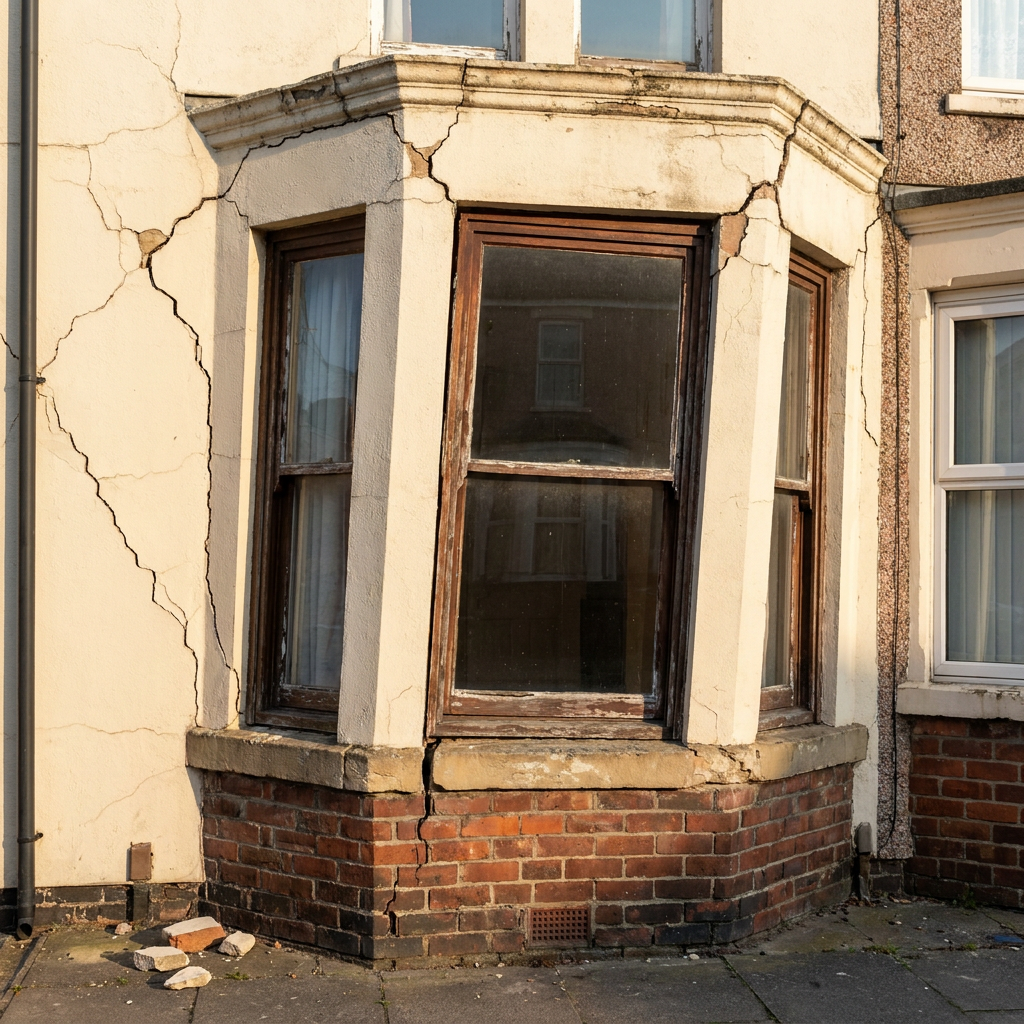
You’ve noticed the top of your bay window has started to dip, perhaps the brickwork above is cracking, or the window frame itself has begun to rack out of square. It’s unsettling, but it’s also more common than you might think — and in most cases, it’s entirely fixable once you understand what’s actually going on structurally.
Key Takeaways
- A dropping bay window lintel is often caused by an undersized or overloaded timber lintel that was never designed for the loads now acting on it.
- Loft conversions and other alterations can redirect loads onto elements that weren’t originally intended to carry them.
- Even small deflections — as little as 3mm — can be significant and warrant a proper structural assessment.
- The typical fix involves replacing the failed lintel with a correctly sized steel RSJ, properly bedded on padstones at each bearing.
- This type of remedial work requires Building Control notification and, in most cases, structural calculations.
What I Found on a Recent Job
I was called to a 1960s semi-detached property in West Yorkshire where the homeowner had noticed the brickwork above the front bay window beginning to crack and the lintel visibly dropping. When I measured it up on site, the lintel had deflected by 3mm — which doesn’t sound like much, but in a relatively short span over a bay window, that’s enough to tell you something has gone wrong with the load path.
The property had undergone a loft conversion at some point in the past. That work had introduced additional loading from the masonry above the bay — essentially, the weight of the gable and roof structure was now bearing down through a load path that hadn’t existed, or hadn’t been properly accounted for, when the original lintel was installed. The existing lintel was a timber section, typical of 1960s construction, and it simply wasn’t designed to carry that kind of load. It was doing its best, but it was losing the battle.
This is a situation I see with some regularity. A loft conversion is completed — sometimes with Building Control approval, sometimes without — and years later the consequences show up at a completely different part of the structure. The bay window lintel, sitting quietly at the front of the house, ends up carrying loads it was never intended to see.
Why 1960s Timber Lintels Are Particularly Vulnerable
Houses built in the 1950s and 1960s were typically constructed with brick outer leaves and timber inner frames or loadbearing masonry inner leaves. Lintels over openings — including bay windows — were often timber, sized to carry the original design loads and nothing more. There was no spare capacity built in for future alterations.
Timber lintels in this era were also frequently installed without the kind of bearing lengths and padstone arrangements we’d specify today. They sat directly on the brickwork, which is fine under modest loads, but once you start adding load — from a loft conversion, a heavy masonry parapet, or even cumulative moisture damage to the timber — the margin disappears quickly.
The other issue with timber is that it creeps under sustained load. Unlike steel, which will hold its position until it reaches yield, timber deflects slowly over time. A 3mm drop measured today might have taken ten years to develop, which is why homeowners often don’t notice until the cracking above the window becomes impossible to ignore.
The Structural Fix: Steel RSJ and Padstones
For the property I visited, my recommendation was to replace the failed timber lintel with a 150×90×8 mild-steel RSJ. The section size was chosen to carry the actual loads now acting on it — including the additional masonry load introduced by the loft conversion — with appropriate deflection limits applied.
Steel is the right material here for several reasons. It doesn’t creep, it can be accurately sized to the load, and it can be fabricated to the exact span required. A properly specified RSJ over a bay window, installed correctly, should last the life of the building without further movement.
Equally important are the padstones at each bearing. I specified a minimum 215×215×100mm padstone at each end. Padstones exist to spread the concentrated point load from the end of the beam over a larger area of masonry, preventing local crushing of the brickwork. Skimping on padstones — or omitting them entirely, as I’ve seen done — transfers all that load into a very small area of brick and mortar, which will fail in time. The padstone size I specified here reflects the bearing loads calculated for this particular beam and span.
Before any of this work begins, a proper propping plan is essential. The masonry above the existing lintel needs to be supported on Acrow props and temporary needles before the old lintel is removed. This isn’t optional — removing a lintel without propping risks the immediate collapse of the masonry above, which is both dangerous and significantly more expensive to repair than the original problem.
The Role of the Loft Conversion
It’s worth pausing on the loft conversion angle, because it illustrates something important about how structural alterations can have consequences elsewhere in a building.
When a loft conversion is designed properly, the engineer or designer will trace every new load through the structure down to the foundations. New steelwork, new purlins, new hanger loads — all of it gets followed through. But sometimes, particularly in older permitted development loft conversions or those done without full structural input, the load paths don’t get fully traced. The masonry above a bay window might not look like part of the loft structure, but if the conversion has altered the roof geometry or introduced new loads into the gable, that masonry can end up carrying significantly more than it did before.
In this case, the loft conversion above had effectively made the masonry over the bay part of a new loading path that the original timber lintel was never designed to handle. It’s a reminder that structural alterations rarely affect only the area where the work is physically carried out.
Building Control and Remedial Work
Replacing a structural lintel — even as a remedial repair — is notifiable work under Part A (Structure) of the Building Regulations. You’ll need to submit a Building Notice or a Full Plans application to your local authority Building Control, or use an Approved Inspector. The work will need to be inspected, and you’ll need signed structural calculations to support the beam specification.
I should be clear that this particular job was a remedial fix after the fact, not a new build or an extension, so certain warranty frameworks didn’t apply. But the Building Regulations obligation remains regardless. A homeowner who skips Building Control on this kind of repair will find it flagged immediately on any future sale, and may struggle to get the work signed off retrospectively.
If you’re buying a property and the vendor mentions a previous loft conversion, it’s always worth asking whether the structural drawings included an assessment of the bay window lintel and other elements below. If they can’t produce them, that’s a reason to commission a structural engineer’s assessment before you exchange.
When to Call a Structural Engineer
If you can see cracking above your bay window, if the window frame is racking or sticking, or if you can measure any visible drop in the lintel or the brickwork above it, you need a structural engineer involved before you instruct a builder. A dropped bay window lintel repair is not a job where you want to be working from a builder’s best guess about what beam to use. The consequences of getting it wrong — partial collapse of the masonry, further movement, failed Building Control sign-off — are far more costly than the fee for proper calculations and a specification. Get the engineering done first, then let your builder price the work from a clear scope.
Need expert eyes on your project?
I am a Chartered Structural Engineer (CEng, MIStructE) based in Huddersfield. The Beam Doctor offers homeowners and builders:
- Steel beam (RSJ) calculations — Eurocode-compliant, Building Control-ready, in 5 working days. See all services and current fees →
- Defect investigation — I attend your property, inspect the cracking or movement, and give you a written opinion on the cause. The site visit is included in the price. See the fee bands →
- Structural Engineer’s Report — a signed desk-based opinion on a single structural concern, for a mortgage lender or an insurance claim. Request a report →
- On-site attendance — a Chartered Engineer at your property, tiered by duration. See site visit fees →
Current fees for every service are listed on the services page.