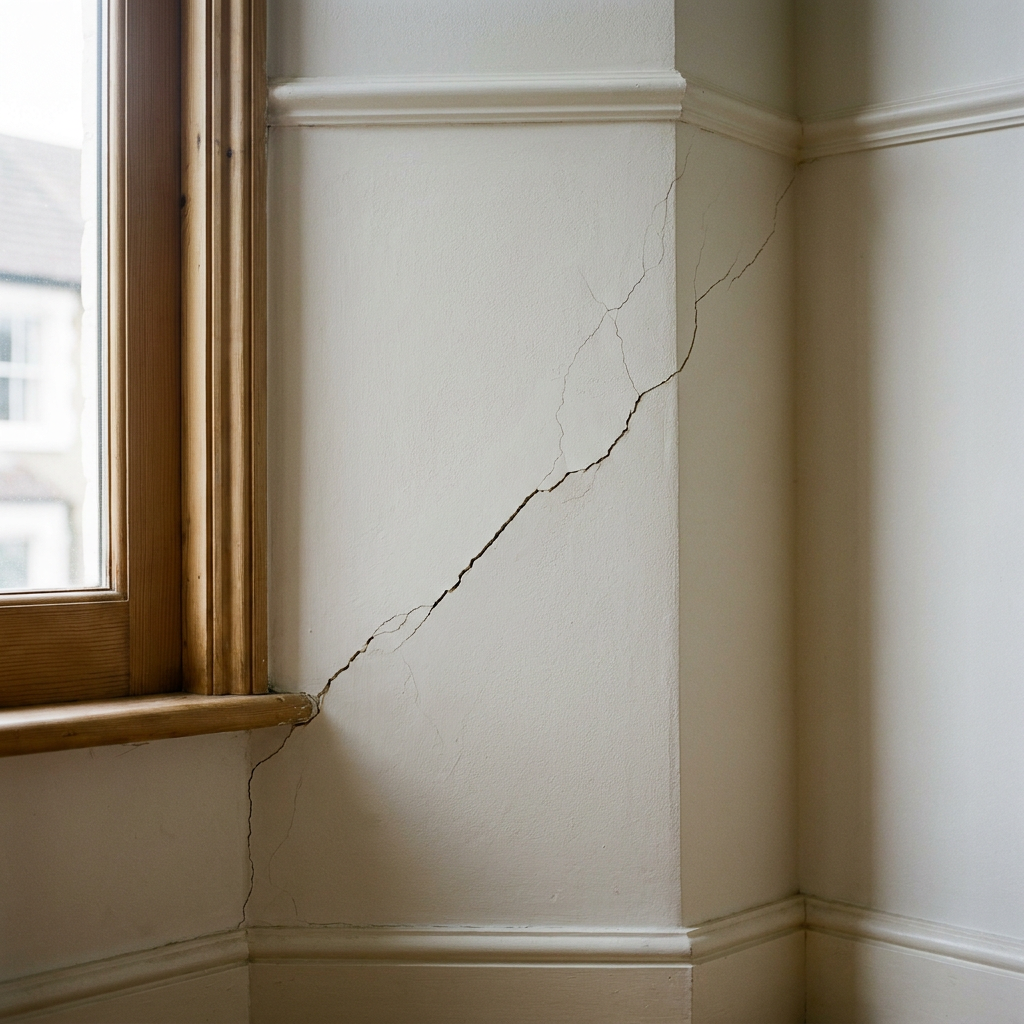
You’ve spotted a crack in your wall and your stomach has dropped. Before you call your insurer or start imagining underpinning bills, take a breath — the overwhelming majority of cracks in UK homes are completely harmless, caused by nothing more dramatic than plaster shrinkage, seasonal temperature swings, or settlement that finished decades ago. This post will give you a practical way to read what your cracks are actually telling you.
Key Takeaways
- Most cracks in walls are cosmetic — caused by thermal movement, plaster shrinkage, or old settlement — not subsidence.
- The BRE Digest 251 damage category scale (0–5) is the standard framework engineers use to gauge severity; categories 0–2 are generally cosmetic, category 3 and above warrant proper investigation.
- Warning signs that justify calling a structural engineer include cracks wider than roughly 3–5 mm, doors or windows that have started sticking, and any crack that is actively widening over time.
- True subsidence risk factors are specific: clay soils, large trees close to the building, and leaking drains. Without those, genuine subsidence is uncommon.
- A structural engineer diagnoses the cause and tells you whether a crack is structurally significant — often from clear photographs and a few measurements before any site visit is needed.
Why most cracks are nothing to worry about
I see a lot of worried homeowners, and the first thing I tell almost all of them is this: your house is not falling down. UK homes move — constantly and imperceptibly — in response to temperature, humidity, and loading. Plaster is brittle, mortar has a finite life, and timber frames dry out over years. All of that produces cracks, and virtually none of it is structurally significant.
The most common culprit I encounter is simple plaster shrinkage. A fresh plaster skim loses moisture as it cures and fine hairline cracks appear within months — sometimes weeks. They look alarming on a freshly decorated wall but they carry no structural meaning whatsoever. Similarly, thermal movement in a brick or block wall causes tiny cracks to open slightly in summer and close again in winter. If you see a hairline crack that seems to change with the seasons, that is almost certainly what you are looking at.
Long-finished settlement is another very common source of cracks in older properties. When a house is first built, the ground beneath it compresses under the new load. This settlement typically completes within the first few years of the building’s life, but the cracks it left behind can remain visible for the lifetime of the property. If a crack has been there for twenty years and hasn’t changed, it is a historical record of movement that is long over — not evidence of anything ongoing.
How to read your cracks: a practical guide
Before you call anyone, spend ten minutes examining the crack properly. The things I want to know when a homeowner contacts me are: how wide is it, where exactly does it sit, does it go through the full thickness of the wall, and has it changed recently?
Width
A crack you can barely see — under about 0.1 mm — is a hairline crack. Up to about 1 mm is still very fine. These are categories 0 and 1 on the BRE Digest 251 damage scale, and they are cosmetic. You can fill them with a little decorator’s filler and forget about them. Once a crack reaches 5 mm or more — roughly the width of a 5p coin — it moves into territory that warrants a proper look.
Pattern and location
Stepped cracks that follow the mortar joints in a staircase pattern through brickwork are the classic sign of differential movement — one part of the wall has moved relative to another. Diagonal cracks running from the corners of window or door openings are extremely common and usually indicate modest differential settlement or thermal movement around the lintel. Horizontal cracks in a brick wall, particularly at mid-height, can be more serious because they may indicate lateral pressure from retained soil or a failing wall tie — that pattern deserves attention.
Internal only, or inside and out?
A crack visible only in internal plaster is almost always a plaster or dry-lining issue. A crack that you can trace in both the internal plaster and the external brickwork, in the same position, tells you the full wall section has moved. That is a more meaningful finding and worth investigating further.
The BRE Digest 251 damage categories
BRE Digest 251 gives engineers and surveyors a consistent language for describing crack severity. It runs from category 0 (hairline cracks, negligible) through to category 5 (structural damage requiring major repair and possible partial rebuilding). As a rough guide:
- Categories 0–2 (up to about 5 mm wide): cosmetic damage. Redecoration or minor repointing is all that is needed.
- Category 3 (5–15 mm, or several cracks grouped together): moderate damage. Doors and windows may be sticking. A structural engineer should assess the cause.
- Categories 4–5 (15 mm and above, or cracks affecting structural integrity): severe to very severe. These require urgent professional input and likely significant remedial work.
In practice, the vast majority of cracks homeowners contact me about fall into categories 0–2. The scale is a useful anchor because it stops people catastrophising a 1 mm crack and, equally, stops them dismissing a 10 mm crack as cosmetic.
The real warning signs of subsidence
Genuine subsidence — ground movement beneath the foundations causing the structure above to drop or tilt — is far less common than the word suggests. When I am assessing whether cracks in walls could indicate subsidence, I am looking for a specific combination of factors.
The first is soil type. Clay soils shrink significantly when they dry out and swell when they rehydrate. In a dry summer, a clay subsoil can lose enough moisture to allow shallow foundations to drop by several millimetres. The second factor is trees. A large tree within roughly its own height of the building will extract significant moisture from clay soil, particularly in summer. The third is drainage. A leaking underground drain can wash fine material away from beneath a foundation, leaving a void. If your property sits on clay, has a large tree nearby, and you have cracks appearing or widening — that combination warrants investigation.
The warning signs I take most seriously are: cracks wider than 3–5 mm that you cannot explain by any other cause; doors or windows that have started sticking or jamming when they previously opened freely; and above all, cracks that are actively widening over time. That last point is the most important. A static crack, however wide, is a historical event. A crack that is growing is telling you something is still moving.
What your insurer does versus what a structural engineer does
These two things are often confused, and the confusion causes homeowners a lot of unnecessary stress. If you report cracking to your buildings insurer as a potential subsidence claim, their process typically involves monitoring — they will want to establish whether movement is ongoing before committing to any remedy. Monitoring can take months or longer. Underpinning, the remedy insurers sometimes fund in confirmed subsidence cases, is expensive and disruptive, and insurers will not authorise it without extensive evidence.
A structural engineer does something different and, in my view, more useful as a first step. I assess the cause of the cracking. I look at the crack pattern, the building’s age and construction, the ground conditions, the proximity of trees, and the drainage layout. I form a professional opinion on whether the cracking is structurally significant, what is most likely causing it, and what — if anything — needs to be done about it. That diagnosis can often be reached from clear photographs and a few measurements the homeowner provides before I even visit the site. It gives you an answer rather than a monitoring programme.
A structural engineer’s report also carries weight with insurers, mortgage lenders, and solicitors. If you are buying or selling a property with cracking, a signed report from a chartered engineer explaining the cause and confirming it is not structurally significant is far more useful than a monitoring schedule.
When to call a structural engineer
Call me — or another chartered structural engineer — if you have cracks wider than roughly 5 mm, if cracks are appearing in both the internal and external faces of the same wall, if doors or windows have started sticking, or if you can see a crack is widening over weeks or months. You should also get professional input before buying a property where cracking is visible, or if your insurer has raised subsidence as a possibility. In many cases I can give you a meaningful initial view from good photographs alone — which means you get an answer quickly and without necessarily incurring the cost of a site visit straight away.
Need expert eyes on your project?
I am a Chartered Structural Engineer (CEng, MIStructE) based in Huddersfield. The Beam Doctor offers homeowners and builders:
- Steel beam (RSJ) calculations — Eurocode-compliant, Building Control-ready, in 5 working days. See all services and current fees →
- Defect investigation — I attend your property, inspect the cracking or movement, and give you a written opinion on the cause. The site visit is included in the price. See the fee bands →
- Structural Engineer’s Report — a signed desk-based opinion on a single structural concern, for a mortgage lender or an insurance claim. Request a report →
- On-site attendance — a Chartered Engineer at your property, tiered by duration. See site visit fees →
Current fees for every service are listed on the services page.