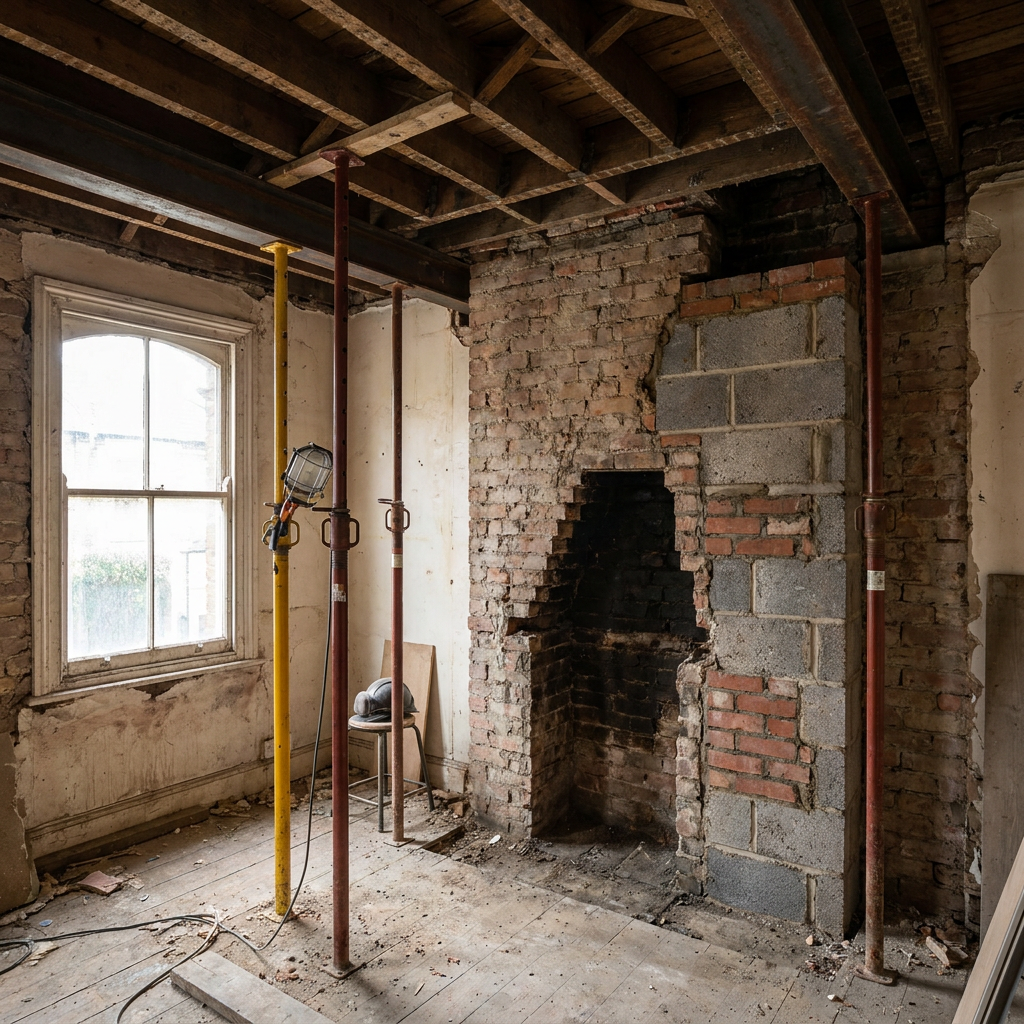
Removing a chimney breast sounds straightforward enough — knock out the brickwork, fit a beam, job done. But on a semi-detached house, where the stack is shared with your neighbour and you’re planning to remove the breast on two floors at once, the structural picture becomes considerably more involved. I want to walk you through exactly what that looks like, because getting it wrong can leave a tonne of masonry with nowhere to go.
Key Takeaways
- Removing chimney breasts on two floors simultaneously requires two separate beams, each designed for a different load — and the first-floor beam carries the more critical one.
- On a semi-detached property, the chimney stack is almost always shared. The Party Wall Act applies, and your neighbour must be served notice before any work starts.
- Whether your neighbour has already removed their breast changes the loading calculation entirely — you need to establish that before calculations are finalised.
- If both floors are being stripped in a single operation, the temporary propping sequence for the loft stack must be specified in writing before a contractor sets foot on site.
- Chimney breast removal structural calculations need to be submitted to Building Control — this is notifiable work under Part A (Structure) of the Building Regulations.
What’s actually happening structurally
A chimney breast isn’t just decorative brickwork. It’s a load-bearing element carrying the weight of everything above it — the breast on the floor above, the stack in the loft, and the section of stack exposed above the roof line. When you remove the breast at ground floor level, you’re cutting out a structural column mid-height. Something has to pick up that load and transfer it to the foundations by a new route.
On the job I’m currently working through — a semi-detached property in the Oldham area — the client is removing the chimney breast on both the ground floor and first floor. That means two beams, not one. The ground-floor beam spans roughly 1,000–1,100mm (based on the drawings provided) and carries the first-floor breast plus everything above. The first-floor beam carries the loft-level stack and, critically, the section of stack that remains exposed above the roof.
That above-roof portion is the part that catches people out. It sits eccentrically — it doesn’t load straight down through the centre of the support. It bears onto whatever is carrying it in the loft, which in this case will likely be a steel or timber gallows bracket bearing onto the party wall and gable. Designing that detail correctly, accounting for the eccentric load and the lateral stability of the exposed stack, is where the real engineering sits.
Why the first-floor beam is the critical one
It might seem logical that the ground-floor beam does the heavier lifting, because it’s carrying more floors of structure above it. But in chimney breast removals, the first-floor beam often governs the design. Here’s why.
The ground-floor beam spans across the opening left by the removed breast and bears onto the remaining wall on either side. It’s a relatively short span, and the loads, while significant, are well-defined. The first-floor beam, by contrast, has to carry the loft stack — which includes the full height of brickwork from ceiling level up to the ridge and beyond. That above-roof stack adds an eccentric, overturning component to the loft support detail that needs careful analysis.
The gallows bracket or equivalent support in the loft doesn’t just carry vertical load. It resists the tendency of the stack to rock or lean, particularly if the stack is tall relative to its base. Wind load on the exposed stack also feeds into this. I won’t finalise the calculations until I have the exact height of the remaining loft stack and the above-roof height, but these are the numbers that will drive the design.
The Party Wall dimension — and why it changes everything
This is the piece that homeowners most often underestimate. On a semi-detached house, the chimney stack straddles the party wall. It belongs to both properties. That means the Party Wall etc. Act 1996 applies, and your neighbour must be served formal written notice before any structural work to the stack begins. This isn’t optional, and it isn’t just a courtesy — it’s a legal requirement.
But the Party Wall Act isn’t just an administrative hurdle. It has a direct structural implication. If your neighbour’s chimney breast is still in place on their side, the load from the shared stack is distributed between both properties. If they’ve already removed their breast — which is increasingly common — the entire stack weight is now bearing on your side alone. That fundamentally changes the load I’m designing for.
On this project, I’ve flagged to the client that establishing the neighbour’s status is essential before I finalise the calculations. If the neighbour’s breast is gone, the numbers go up. A party wall surveyor appointment should run in parallel with the structural design process, not after it. The two workstreams need to talk to each other.
Information I need before calculations can begin
This is a project at quoting stage — no contractor is appointed yet — so I’m working from drawings and initial information. Before I can produce Building Control-ready calculations, I need the following confirmed:
- Floor-to-ceiling heights at ground floor and first floor
- Chimney breast wall thickness and construction (brick or blockwork, and which bond)
- Party wall thickness and the neighbour’s breast status
- Floor joist direction on both floors — this affects how the trimming detail around the breast opening is designed
- Height of the remaining stack in the loft, and the above-roof height to the top of the pots
It’s worth noting that floor joist direction matters more than people expect. If the joists run parallel to the chimney breast rather than into it, the trimming arrangement changes. You may need a trimmer joist and trimming joist to redistribute load around the opening, and the bearing details need to be designed accordingly. I can’t assume the joist direction from a plan alone on older housing stock.
The temporary propping sequence — a red flag worth taking seriously
Here’s the scenario I want to avoid: a contractor arrives on site and decides to crack on with both floors in a single operation. They strip the ground-floor breast, then immediately move upstairs and strip the first-floor breast before the ground-floor beam is installed and properly bearing. For a brief period, the loft stack has no support path to the foundations. That’s not a theoretical risk — it’s a real one, and it can cause the stack to move or drop without warning.
The temporary propping sequence must be specified in the structural engineer’s drawings and notes before work starts. Typically this means Acrow props and temporary needles installed to carry the loft stack before any permanent brickwork is disturbed, with a defined sequence for installing each beam and achieving full bearing before the props are struck. The contractor should not be left to improvise this on site.
If you’re getting quotes and a contractor doesn’t mention propping sequence, ask them directly how they intend to support the loft stack during the works. Their answer will tell you a lot about their experience with this type of job.
Building Control and the calculations package
Chimney breast removal on a load-bearing stack is notifiable work. You need to submit structural calculations to Building Control under Part A (Structure) of the Building Regulations — Approved Document A sets out the framework. The calculations package for a two-floor removal like this will cover both beams, the padstone design at each bearing, the loft gallows bracket or equivalent, and the trimming details around the floor openings.
Getting this submitted before the contractor starts means the inspector can check the design, and your contractor has a document to work from. It also protects you if you ever sell — a buyer’s solicitor will ask for evidence that structural alterations were done with consent, and a Building Control completion certificate is the document that provides it.
When to call a structural engineer
Any chimney breast removal on a semi-detached or terraced house — where the stack is shared — needs a structural engineer involved from the start. If you’re removing on more than one floor, if the stack above the roof is tall, or if you have any reason to think the neighbour’s breast may already be gone, the complexity increases further. Don’t wait until a contractor asks you for calculations. Appoint the engineer early, let the structural and party wall workstreams run in parallel, and make sure the propping sequence is written into the specification before anyone picks up a hammer.
Need expert eyes on your project?
I am a Chartered Structural Engineer (CEng, MIStructE) based in Huddersfield. The Beam Doctor offers homeowners and builders:
- Steel beam (RSJ) calculations — Eurocode-compliant, Building Control-ready, in 5 working days. See all services and current fees →
- Defect investigation — I attend your property, inspect the cracking or movement, and give you a written opinion on the cause. The site visit is included in the price. See the fee bands →
- Structural Engineer’s Report — a signed desk-based opinion on a single structural concern, for a mortgage lender or an insurance claim. Request a report →
- On-site attendance — a Chartered Engineer at your property, tiered by duration. See site visit fees →
Current fees for every service are listed on the services page.